
Role focus
Solo full-stack: Go API, React web, Expo mobile, Python ML, plus verification and cryptographic signing
Backend testsWeb + ML testsMaturity
Flagship Build — Multi-tenant Agritech Trust Platform
The flagship of the archive — a multi-tenant platform that turns everyday Zambian farm activity into evidence a lender can trust, combining farm record-keeping with GPS-, cadastre-, and satellite-based verification behind a signed farm track record and transparent credit score.
Role focus
Solo full-stack: Go API, React web, Expo mobile, Python ML, plus verification and cryptographic signing
Project narrative
SmartFarmer is the deepest system in the archive because it treats a hard problem — smallholder farmers excluded from credit for lack of a verifiable history — as an engineering problem. It records farm activity through the season, then verifies that activity against independent, hard-to-fake external sources, answering a lender's real question (“did this farm actually do what it claims”) with signed evidence rather than self-report. It ships as four cooperating services — a Go API, a React web dashboard, an Expo mobile app, and a Python ML service — with tenant isolation enforced all the way down to PostgreSQL Row-Level Security.
Why it matters
Polyglot full-stack delivery across Go, TypeScript/React, React Native, and Python in one coherent system
Security- and trust-minded engineering: RLS tenant isolation, route-level RBAC, and cryptographic signing with tamper detection
Systems-integration depth: satellite (Sentinel-2), the national cadastre (ZNSDI), and an ML service wired into one product
Preview Gallery
Interface views and system visuals that help the product story read quickly. Tap any screenshot to view it full size.
The field dashboard in the Expo app: an AI advisory feed that surfaces expert-confirmed alerts — Fall armyworm, Lumpy skin disease, a soil-moisture risk — ranked by severity, with quick actions for the work a farmer actually does.
Recording a soil test. The reading is stamped with a captured GPS point and signed against a server time anchor on the device, so it stays tamper-evident even when it syncs later from the offline queue — the trust layer, shown in the UI.
Worker GPS against a live farm geofence: in-bounds movement, out-of-bounds anomaly flags, and a reliability rating computed from geofence adherence — the raw field signal behind a verified work record.
AI photo triage for livestock health, deliberately framed as a screen and not a diagnosis. The result enters an expert review queue — only a vet or camp officer's verdict updates the herd record.
The AI crop disease scanner running a maize leaf through Gemini: a named diagnosis (Maize White Streak Virus), a confidence score, a severity rating, and locally appropriate treatment steps.
The AI agronomist advisor turning a Chongwe District forecast into prioritized, crop-specific actions grounded in the farm's own soil-moisture and crop records.
Architecture map
Web + mobile
A React 19 + Vite dashboard for owners and managers (farm records, lender track record, satellite health) and an Expo React Native app for field workers (GPS attendance, tasks, AI crop scanner).
Go API
An Echo/GORM service holding domain logic, JWT auth, route-level RBAC, tenant middleware, and the cryptographic signing of the lender track record.
Verification + ML
A Python/XGBoost yield-and-revenue service, Sentinel-2 NDVI via Copernicus, the ZNSDI cadastral geoportal for land-parcel checks, and a Gemini/Anthropic farm advisor.
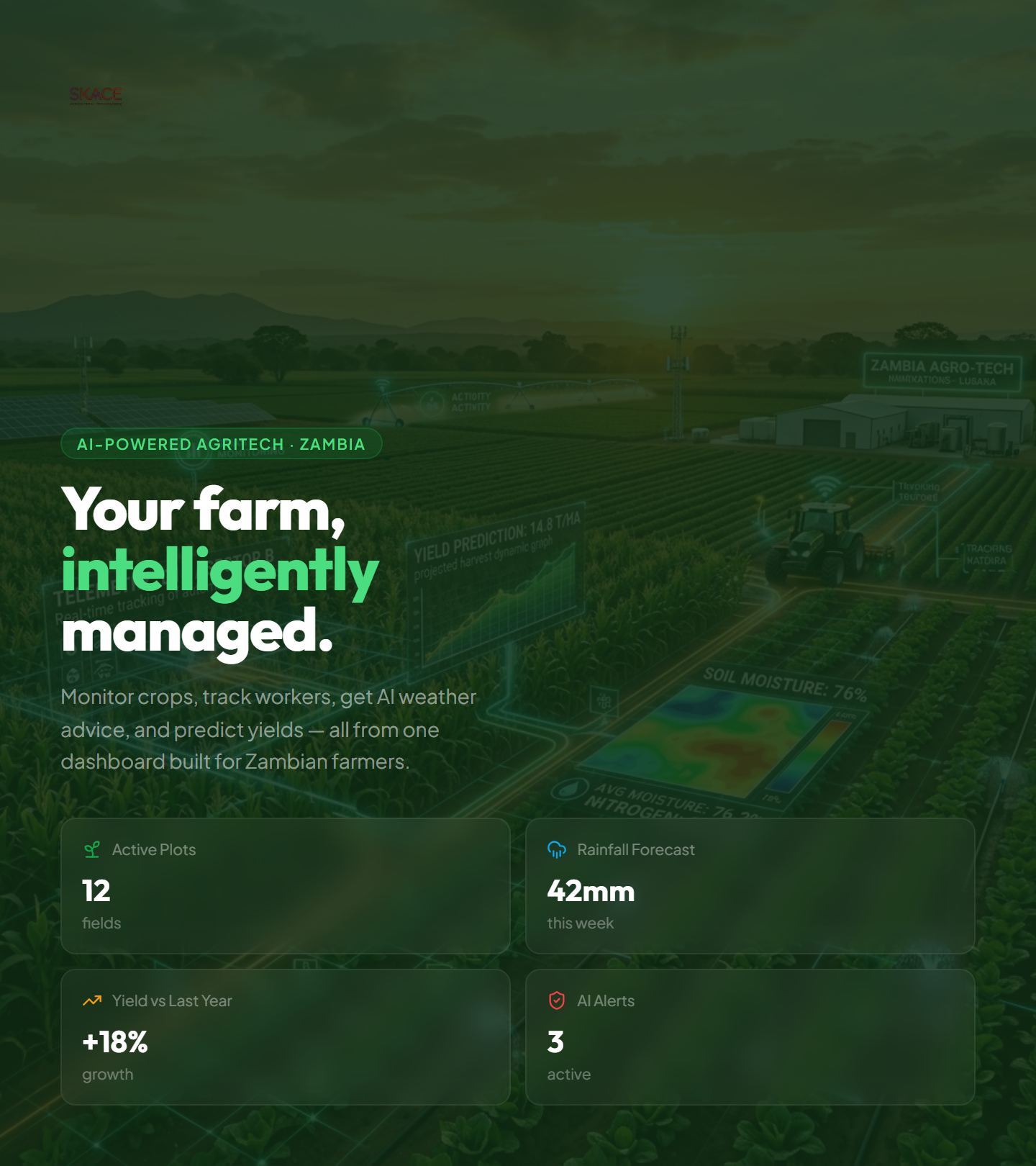
Architecture overview highlighting how the frontend, backend, and data flow connect.
Engineering Decisions
Beyond features, this section highlights the structural choices that shape scalability, reliability, and product clarity.
Validation snapshot
Go suites cover tenant isolation and RLS, route-level RBAC (including a regression that a field worker is rejected from every mutating endpoint), signed track-record tamper detection, and satellite NDVI logic — all passing under `go test ./...`.
Frontend Vitest (3/3) and the Python ML service unittest suite (9/9) pass.
Best positioned as a production-minded MVP with strong architecture and verification, not a fully mature enterprise deployment.